
May 21, 2026 · 7 min read
How to Help a Sensitive or Fearful Dog Handle New Environments
By Andrew · Trail & Heel
Some dogs walk into a new place and act like they have been there a hundred times. Other dogs do not.
For sensitive or fearful dogs, a new environment can feel overwhelming fast. A dog who listens well at home may suddenly forget most of their obedience in a busier setting. That does not always mean the dog is being stubborn. Often, it means the dog is stressed.
This is exactly what can happen when a sensitive dog is brought into a busier public place before they know how to recover there.
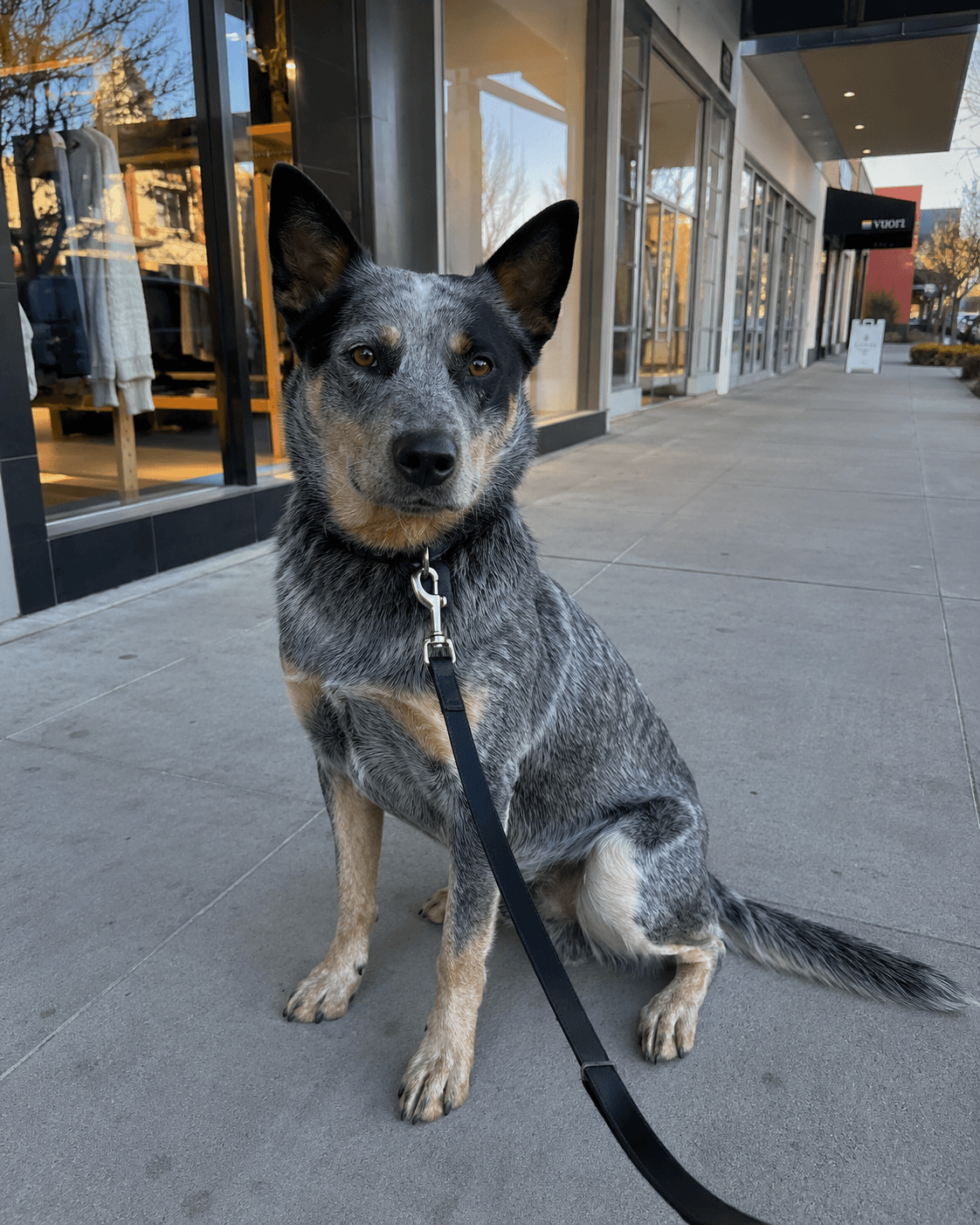
A dog can be smart, sweet, and fairly obedient in calm environments, then struggle hard when the setting changes. Busy places can make the same dog look like they forgot everything they know.
The noise, people, kids, smells, movement, and unfamiliar surfaces can be a lot for a fearful dog. In that setting, a dog may lose most of the obedience they normally have.
That is common with fearful dogs.
A dog may know how to sit, walk nicely on leash, check in with the handler, or settle in a quiet place. But once stress gets high enough, those skills can disappear. The dog's brain shifts away from training mode and into survival mode.
Why dogs get fearful in new places
Fear in dogs can come from several places.
Sometimes it is lack of socialization. A dog may not have had enough safe, positive exposure to different environments during puppyhood.
Sometimes it is breed tendency. Herding breeds, including heelers, border collies, and Australian shepherds, can be very aware of movement, sound, and environmental changes.
And sometimes it is just the dog's personality.
Some dogs do not like strangers. Some do not like screaming kids. Some do not like automatic doors, slick floors, loud carts, or strong smells from stores. A shopping mall might seem normal to us, but to a nervous dog, it can feel like too much information at once.
Should you take a fearful dog to busy places?
With a sensitive dog, you have two realistic options.
The first option is acceptance.
Not every dog needs to go everywhere. Your dog does not have to enjoy the mall, the farmer's market, the brewery patio, or a crowded downtown street. If your dog is deeply uncomfortable in those places, it is completely fair to say, "This is not for them."
That is not quitting. It is good judgment.
The second option is slow desensitization.
If the dog needs to handle more public environments, or if the owner wants to work toward that goal, the process has to be gradual. You do not fix fear by throwing the dog into the deepest version of the situation and hoping they figure it out.
That usually makes things worse.
If the goal is to help the dog become more comfortable in public spaces, the work starts with distance, time, and a realistic version of success.
How desensitization works for a fearful dog
The basic process is simple:
- Go near the stressor, but stay far enough away that the dog can still recover.
- Reinforce calm behavior.
- Repeat over time.
Simple does not mean easy.
The most important part is staying below the dog's breaking point whenever possible. If the dog is panicking, lunging, refusing food, scanning constantly, or unable to respond at all, they are probably too close to the stressor or too overwhelmed by the environment.
In a busy place, I usually start at a distance from the hardest parts of the environment.
At first, the dog may be too stressed to eat treats, play, or do basic obedience. Their head may stay on a swivel. They may pant. Every person walking by may seem like a possible threat.
I do not treat that like disobedience. I treat it like a dog who needs time to process.
So we did very little.
I keep people away from the dog. I do not let strangers approach. I do not ask for a bunch of commands. I do not drag the dog through the environment to get used to it.
I let the dog exist at a safe distance while I watch their body language.
That part is boring, but it matters. With fearful dogs, progress often starts when they realize nothing bad is happening. They need time to observe the environment without being forced into interactions they are not ready for.
What calm looks like in a fearful dog
Calm does not always mean the dog lies down and takes a nap.
For a nervous dog, calm might look like:
- Softer eyes
- Less panting
- A looser body
- The ability to look away from people
- Taking food again
- Sniffing the ground
- Checking in with the handler
- Standing or sitting without trying to flee
After enough time at a safe distance, the dog may finally settle a bit. If they relax enough to take food, that is worth rewarding heavily.
That was a win.
Not because the dog is suddenly fixed. They are not. But they have moved from too stressed to function into able to take food and process the environment.
That is the first step.
A few minutes later, something may happen that spikes the dog again. A kid runs by screaming. A cart rattles past. A stranger gets too close. That is normal. Desensitization is not a straight line.
The difference is that recovery can get faster with practice. Instead of taking 30 minutes to settle, it may take closer to 5 or 10.
That matters more than people think.
Do not ask too much too soon
One mistake people make with fearful dogs is asking for obedience too early.
They want the dog to sit, heel, watch, leave it, stay, and behave perfectly in a place where the dog barely feels safe.
That is too much.
In a session like this, I do not care about perfect obedience. I care about emotional recovery. I want the dog near me, not pulling, and able to settle after something startles them.
That was enough for one session.
When a dog is fearful, obedience improves after the dog feels safer. Not before.
Will one training session fix a fearful dog?
No. One session will not completely change a fearful or sensitive dog.
But one good session can help.
The dog learns that the environment is survivable. The handler learns what distance the dog needs. Everyone gets a clearer picture of what the dog can handle right now.
For a fearful dog, one careful outing is a small step. With consistent practice, many dogs can learn to handle more environments than they can today. They may never become completely neutral in every loud, crowded place, and that is okay.
The goal is not to turn every dog into a public-access robot.
The goal is to help the dog feel safer, recover faster, and build confidence one manageable exposure at a time.
Final thoughts
If you have a sensitive or fearful dog, do not assume they are trying to be difficult. Stress can make a trained dog look untrained.
Start farther away than you think you need to. Keep sessions short enough that the dog can succeed. Protect your dog from people who want to rush up and say hi. Reward the small moments of calm.
And remember, acceptance is allowed.
Some dogs can learn to enjoy busy places with time and careful work. Some dogs would rather stay home, go on quiet walks, and skip the mall completely.
Both are fine. The important thing is knowing the dog in front of you and not forcing them into a version of life they are not ready for.